Medicine Wagon
Big Medicine
Chapter 6—The Deputy
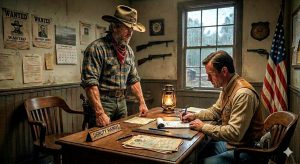
Sheriff Perry Owens was in St Johns.
Nobody in Concho Valley said that like it mattered, but it did matter. The deputy holding down the office that morning was a narrow young man named Watt Pruitt.
And Watt Pruitt smelled trouble the ordinary way, through the nose and the hairs on his arms and eleven months of watching Owens do the job right.
He didn’t have the frequency. He just had good instincts and a badge that fit him a size too big in the shoulders.
Lynch came out of the Dusty Biscuit into a morning that already had opinions about him.
“Mister Lynch.” Watt had his thumbs in his belt, working up to something.
“Got a complaint filed.”
“Figured you might.”
“Yuma Slim’s got a hole in him.”
“He does.”
“Gutshootin’, specifically.”
Lynch looked at him for a second, recognizing a fact he already agreed with.
“He drew first,” he joked with a lie.
“Don’t doubt it, sir.”
Watt didn’t doubt it. That was the trouble. A man who didn’t doubt it still had a form to fill out.
Judge Calloway’s gonna want you in St Johns for it. County seat. Fifteen miles.”
“When.”
“Today’d be most favorable to everybody’s schedule.”
Med came around the front of Traveller with his coffee, unbothered, like he’d already read the whole morning off a handbill somewhere.
“Court date, is it.”
“Yessir. Him too, if he’s inclined to witness.”
“I’m always inclined toward St Johns,” Med said, which meant nothing and everything, the way most things Med said meant both.
Lynch finished his coffee standing up.
Somewhere behind him Franz Grimm was extracting the last of the lead out of Yuma Slim with the tongs and the strop.
Yuma Slim would not be riding fifteen miles to testify against the man who shot him, on account of being professionally occupied in a barber chair with his teeth clenched.
Everybody in Concho Valley understood this without a word being said about it.
St Johns sat up out of the grass as if it decided, sometime around 1875, to be a place with a courthouse and stuck to the decision through sheer stubbornness.
Lynch and Med rode in together, Traveller and Jeb making better time than the wagon usually made alone, like even the Percherons knew this was a straight errand and not a huck.
The courthouse square had the kind of afternoon quiet that only county seats managed, two lawyers arguing in low voices under an awning.
A clerk somewhere behind an open window was scratching a pen across paper.
Archive shelves ran along the back wall, deed books and survey volumes standing shoulder to shoulder. Like a company of soldiers nobody remembered mustering.
His gaze went down the spines, without appearing to look at all, and it caught on a fat volume marked:
1873 — SURVEYS, APACHE CO.
Leather gone soft and gray at the corner.
He took it down. Nobody looked up. The clerk kept scratching. The lawyers kept arguing about a fence line.
The key was folded once inside the front cover, waiting the way things in this business waited, apparently, without hurry, without doubt that somebody would eventually come.
He didn’t touch it yet.
He looked around the room same way a man checks a saloon before sittin' with his back to the door.
Clerk. Lawyers. Nobody watching a man read a land survey.
He touched it. The hum come up through his fingers.
But it wasn’t the bone-deep ring the resurrection page put in him at the fire, back before Medicine Man had turned it to smoke.
This was thinner. Waiting instead of burning.
Like a bell that hadn’t been struck yet, but surely knew its note. He folded it. Put it in his pocket.
The cavalry boot had already survived a hanging tree. A courthouse seemed light duty by comparison.
He’d transfer it from pocket to boot on the way home.
Outside, through the tall window, Medicine Wagon with the Percherons was standing dead still.
“Lynch.”
He almost turned around to see who they were calling. Almost.
“Mister Lynch. Is that the party?”
He went and stood in front of the bench instead of answering.
Judge Calloway was an old man with spectacles pushed up on his forehead and the wosdom of a man who’d spent thirty years listening to men explain violence.
He had Watt Pruitt’s report in front of him.
From the way his mouth was doing something under his mustache, the report read the way lawman reports generally read.
It was a plain, careful account, of an event that hadn’t happened the plain, careful way it was written down.
“Says here Yuma Slim declined to appear,” the Judge said.
“Indisposed, Your Honor,” Med offered helpfully from the gallery, hat in his lap like a man at church.
“Indisposed.”
“Franz Grimm’s got him.”
The Judge looked like a man filing information somewhere useful for later.
“Mr. Lynch. He drew first?”
“He did.”
“Still a gutshootin.”
The Judge said it without heat, the way Watt had said it, a fact that existed independent of anybody’s opinion about fairness.
He looked at Lynch a moment longer than the paperwork actually required.
Big man. Quiet. The kind of quiet that made a courtroom feel smaller.
“Case dismissed. Don’t gutshoot people in my county no more.”
“Yessir.”
“You smell like trouble, son.”
“Yessir.”
Lynch was already reaching for his hat when the gavel came down.
Across the square, through the tall glass of the St Johns Court, he could see a lawman with a hat in his hand was working up to something much harder than a gunfight.
Commodore Perry Owens had ridden fifteen miles on county business, which resolved itself by eleven in the morning.
Then he spent the better part of two hours finding reasons to still be in St Johns.
He’d watched Lynch tie Charger to the courthouse rail from clear across the square, the liminal frequency between them humming quiet and certain as a tuning fork.
He said not one word about it, because that wasn’t Owens’ business today. Nice horse, he thought, and went into the library.
Pearl looked up from the catalog she was updating and didn’t stop updating it right away.
Because Pearl had been waiting for Owens considerably longer than Owens had been working up to coming, and a woman with that kind of patience doesn’t waste it all in the first five seconds.
“Perry.”
“Pearl.”
He set his hat on the counter like it was a peace offering.
She closed the catalog.
There were three documents in that library, besides the one Lynch had just lifted out of the front cover of a survey volume, with that same quality, suggesting a person oughtn’t touch them.
Pearl had known about all three for years.
She’d filed the 1873 survey herself, noticed the folded page, and left it exactly where it lay, because it came in with the document, and belonged with the document.
Pearl’s filing philosophy did not admit of exceptions.
He asked her instead if she’d care to come to the harvest festival over in Snowflake.
She said yes before he finished asking, then looked faintly surprised at herself for it.
Owens put his hat back on with the satisfaction of a man whose errand to the county seat went correctly and that mattered to him.
He went back out across the square with his hat sitting at a slightly different angle than when he’d gone in.
Lynch, coming down the courthouse steps, watched him go and in his turn, chalked it up under ‘that went well for him,’ swinging up onto Jeb.
There was still the matter of the fighting-without-a-permit fine, which in St Johns, as in Concho Valley, went to the fire department.
Frontier logic was, the institution most likely to require funding generated by men beating on each other in the street was the one that put the fires out afterward.
The fireman took Lynch’s double eagle with the good humor of a man whose whole operating budget ran on this exact revenue stream.
Med had the Medicine Wagon already pointed back toward Concho Valley, like the wagon had decided the direction before either of them.
“How’d it go.”
“Double eagle at the firehouse. Fightin’ without a permit.”
“Mm.”
“Gutshootin’ dismissed.”
Med nodded, like a man confirming something he’d already known.
He consulted his handbill.
“Slim declined to appear.”
“Franz had him in the chair.”
“Mm, hm.”
They rode. The key sat quiet in Lynch’s pocket, next to the fine order and the firehouse receipt, three pieces of paper and one thing that wasn’t paper at all, riding together.
He didn’t mention it. Med didn’t ask.
Jericho and Nineveh walked their steady walk. Concho Lake sat between the two towns, as thresholds often do, unremarked upon until you’re standing in one.
Lynch pulled up at the edge of the lake in the low gold light of late afternoon, let Jeb’s reins drop, and the big roan waded in to drink while the day’s dust settled off both of them.
It had been a long stretch of road since morning. Canyon Diablo’s zombie raiders felt like a month back instead of a week.
He sat on a flat rock at the water’s edge and took his hat off, running a hand back through his hair, brown with red mixed through it, the middle part showing itself.
Just a man combing his hair at a lake between one town and the next. He looked down at his reflection to check his part was straight.
The Crimson Lady looking up at him from the lake scared the bejeezus out of him as he jumped back, heart racing, landing on his ass one knee down.
It was her, he didn’t know how he knew her, heart racing before she was in his mind.
Jeb’s head came up from the water, ears forward.
Coming up through the surface without disturbing it, the nickel plated Peacemaker broke the surface barrel first vertically, water sheeting off the nickel in the afternoon light, held up as an offering.
A presentation, maybe, or just a handoff.
Lynch didn’t startle easy. He’d swung from a rope and not died.
Stood against dead Confederate raiders while a woman with a Bible and a machete conducted a small war nearby.
None of that scared him like this, because this was her, and he knew her the way a man knows a name he can’t say.
Lynch’s big paws closed around the grip before he decided to reach for it. 4He thumbed the hammer back once, checked the action. Smooth, oiled, loaded, of course loaded.
Eased the hammer forward again.
He looked at the lake. Just his own reflection now. The rope scar sat pale above his collar in the image looking back at him. His part had come undone.
Jeb put his muzzle back in the water and drank like nothing at all had happened.
Lynch looked at the gun a long while. It was too fine a piece for Canyon Diablo mud, too fine for a working man’s belt.
The kind of gun that belonged in the hand of a woman lying on her side under a parasol, painted in crimson down the flank of a wagon that shouldn’t exist.
He put it in his belt. Took his boot off, added the fine order and the firehouse receipt in, riding against his calf and put the boot back on.
He mounted up without a single word to the lake, which gave him none back.
Med had already made a small notation on a handbill three days prior, in his own geometric hand, that read, roughly translated, lake delivers.
When Lynch rode up beside Traveller with a nickel plated Peacemaker sitting naked in his belt, Med looked at it as long as it was polite, not one second longer.
He said nothing, which coming from Med was its own kind of confirmation. They didn’t mention it for the rest of the ride into Concho Valley.
Herbert saw the gun before he saw Lynch’s face, and his pencil hand went still over the ledger. It was outside the normal range of what came through the door at Harris mercantile.
“That’s a hundred dollar gun.” Not a question. Herbert dealt mostly in observations that contained several unasked questions inside ‘em.
Same way a good fence holds several unlisted opinions about your cattle.
“Yeah,” Lynch said. “Perfect match for the one I bought here yesterday."
“Where’d you get it?”
Lynch looked at him. “Lake.”
Herbert looked at the gun. Looked at Lynch.
Looked at the gun again, went to find a holster equal to the occasion. He came back with good oiled leather and, setting it on the counter, then took in the rest of the man properly, first time that day, distracted the previous day watching Buck Roy’s stolen hat ride past the window.
“Hat looks good on you, Mr. Lynch.”
Entirely sincere. Herbert didn’t often get to exercise his opinions about hats in a professional capacity, and clearly meant to enjoy this one.
Lynch touched the brim. “Thank you, Herbert.”
“Can get you a fighting permit here too, while you’re at it.”
Herbert set this down with the particular timing of a man who’d been waiting all week for the right customer to say it to.
“Along with a fishing license.”
Lynch looked at him. “Same price?”
“Different forms.” Herbert said this with complete seriousness. “Fighting permit’s got more boxes.”
He produced the pad from behind the counter. A small hand-lettered price card hung there too, Mildred’s careful lettering neatly applied.
He began filling in boxes with the economy of a man who’d done this before and expected to do it some more.
“Name.”
“Lynch.”
“First name.”
Lynch looked at him.
“Just Lynch,” Herbert said, and wrote it down without further inquiry.
“Occupation.”
Lynch considered the box a moment.
“Drifter.”
Herbert wrote that down too, without comment, because drifter was at least specific.
Mildred appeared from the back room, looked at the nickel plated Peacemaker settling into its new holster, then at Herbert.
Herbert gave her the look meaning ‘lake.’
Mildred’s eyebrows did something and she went to the back room.
Herbert tore the fighting permit off the pad with a flourish and slid it over. Without missing a stride, he slid a second slip right after it.
“Bearer authorized one fight per day, under applicable rules, within Territory limits, excluding lakes and waterways.”
He read the exclusion as a man reads work he’s proud of.
“Figured you’d best get the fishing license same time. After all,”
And here Herbert gave the unhurried weight of an opinion he’d been saving since the gun came through the door, “you do seem to be catchin’ things there.”
Lynch looked at the fishing license.
Herbert’s pencil was already moving on to the next box, entirely unbothered, a need to meet.
Lynch folded both slips and looked at his boot, already full.
He put ‘em in his pocket instead, next to the fine order and firehouse receipt.
Four pieces of official Apache County paper riding against his chest now. Not one could tell him the one thing he actually needed to know, his own name.
Fighting permit, the fishing license, gutshot dismissal, a charge and a fine filed away in St Johns.
Every document a man could reasonably ask a frontier territory to produce, agreed completely, and every one was wrong, in exactly the right way.
Because the name on all of it was a name Med gave to a half-dead man at a fire in the desert.
He touched his hat brim to Mildred and went out. She was straightening the mannequin’s collar in the doorway with the studied, casual ease of a woman noting something for later.
“Hundred dollar gun, Herbert,”
“Surely, ma’am,” Herbert said.
“What did he pay for that other nickel plate Peacemaker yesterday? A hundred?"
“No,” said Herbert. “Boss put that man in Hell. And Hell coughed him up. I charged him ten. Hartley’s Crew will pay for that one. Probably his gun anyway.”
She stopped and tilted her head, considering.
“His gun? How do you know Boss did something to Mr. Lynch, Herbert?”
“Written all over the man from front to bottom, top to back.”
“Which lake, you say?"
“Concho Lake.”
Mildred considered, both this and the street outside, Concho Lake visible in the gap between buildings, silver dark, unremarkable here, the last of light.
“Of course it is,” said Mildred, and went back to the collar.
***
Lynch found Med a mile or so down the road, Medicine Wagon rollin’ easy in the blue evening breeze.
He showed him the fishing license without a word. Med checked it for a while.
He was genuinely interested, studying with a scholar’s focus, inspecting small features like a double border.
It was tastefully interweaved in red and blue double borders, finished as an arrow head in each corner.
“Herbert.”
“Yep.”
Med handed it back, making a notation on the handbill in his lap, geometric symbology over small certainties.
“Good man,” was all Med had to say. “Good work.”
The gun rode quiet in new leather, its hum settled down low, patient instead of urgent and ready. Present, yet willing to wait.
A different hum than the index page, he realized, riding in his boot with the fine, dismissal orders and the rest.
The page hum said, ‘this belongs to the work.’
He hadn’t figured out yet what the gun hum was. Only that it was different.
They rode into the cooling evening, Lynch now the most documented “anonyman” in the county.
Now with a fishing license that authorizrd im to keep whatever that lake eventually relinquished.
But he still didn’t remember his own name.